
This is part 2 of the blog series "Measuring pressure difference in practice", in which we use hands-on tests to find out which factors affect pressure difference measurement results – and which don't.
Part 1: The effect of equipment – How do the material, length and type of tube affect measurement results?
Part 2: The effect of placement (this article) – How does the meter's position and installation height affect the results?
Part 3: The effect of wind – How do wind direction and strength affect a building's pressure difference?
Why did we test this?
In the previous part we looked at how much the measuring equipment itself – tube, pipe, length – affects the results. Now we move on to the next question: where should you actually put the device and the tube?
The measurement guidelines (2019) published by A-Insinöörit instruct you to measure pressure difference at a height of about 1 metre above the floor. This is not an arbitrary choice, and these tests show why. We also look at what measuring at a height of 1 m actually means – and what it doesn't.
TL;DR
-
The location of the measuring device (floor vs. ceiling) does not affect the results – perhaps somewhat surprisingly
-
The height of the wall penetration, on the other hand, is what really matters
-
Vertical tube runs do not affect the results
-
In our test, the pressure difference upstairs and downstairs differed by about 2.3 Pa – exactly the value predicted by thermal pressure difference
-
Moving measurement tubes can cause interference spikes in the measurement results
-
Pressure difference varies surprisingly much within a building – simply opening a door causes a spike of almost 15 Pa
A quick physics refresher
Air pressure decreases with altitude – at sea level by about 12 Pa for every metre you go up. This has little effect on pressure difference measurement, because gravity is the same both indoors and outdoors.
Temperature, however, does matter. The same principle that lifts a hot-air balloon into the sky also applies to buildings: warm air is lighter than cold air. When it is warmer inside than outside, the warm air tends to rise and escape through the upper parts of the building. Negative pressure develops downstairs as air is drawn in to replace the air that has escaped upwards. Upstairs, on the other hand, there may be positive pressure as the warm air looks for a way out.
This phenomenon is known as the stack effect, and in practice it means that pressure difference depends on the measurement height. Whether you measure downstairs or upstairs, the result can be completely different.
Claims tested
- The measuring device must be installed at the height of the wall penetration – common assumption
- Pressure difference differs between floors (thermal pressure difference) – A-Insinöörit measurement guidelines, p. 17
- Vertical tube runs affect measurement results and should be avoided – common assumption
- The way the tube is fastened affects measurement results – practical observation
Test set-up
Test site
The same building as in part 1: an 80-year-old two-storey detached house with natural ventilation. The floors are connected by an open staircase.
Equipment
Two Loop Delta pressure difference meters were used in the test:
- 9395 PVC tube, 3 m
- 9213 PVC tube, 3 m
From the previous part we know that a 3-metre PVC tube does not cause any significant measurement error. The wall penetration was about 2 metres above the floor – not the 1 m recommended by A-Insinöörit, but that's where a ready-made penetration happened to be. This is not a problem, because we know about it.
Test 1: Devices at the same height – calibration
First, we made sure that both devices measure the same thing. We connected a 3-metre tube to each, ran the free ends of the tubes outside to exactly the same spot and placed both devices at the same height as the wall penetration.
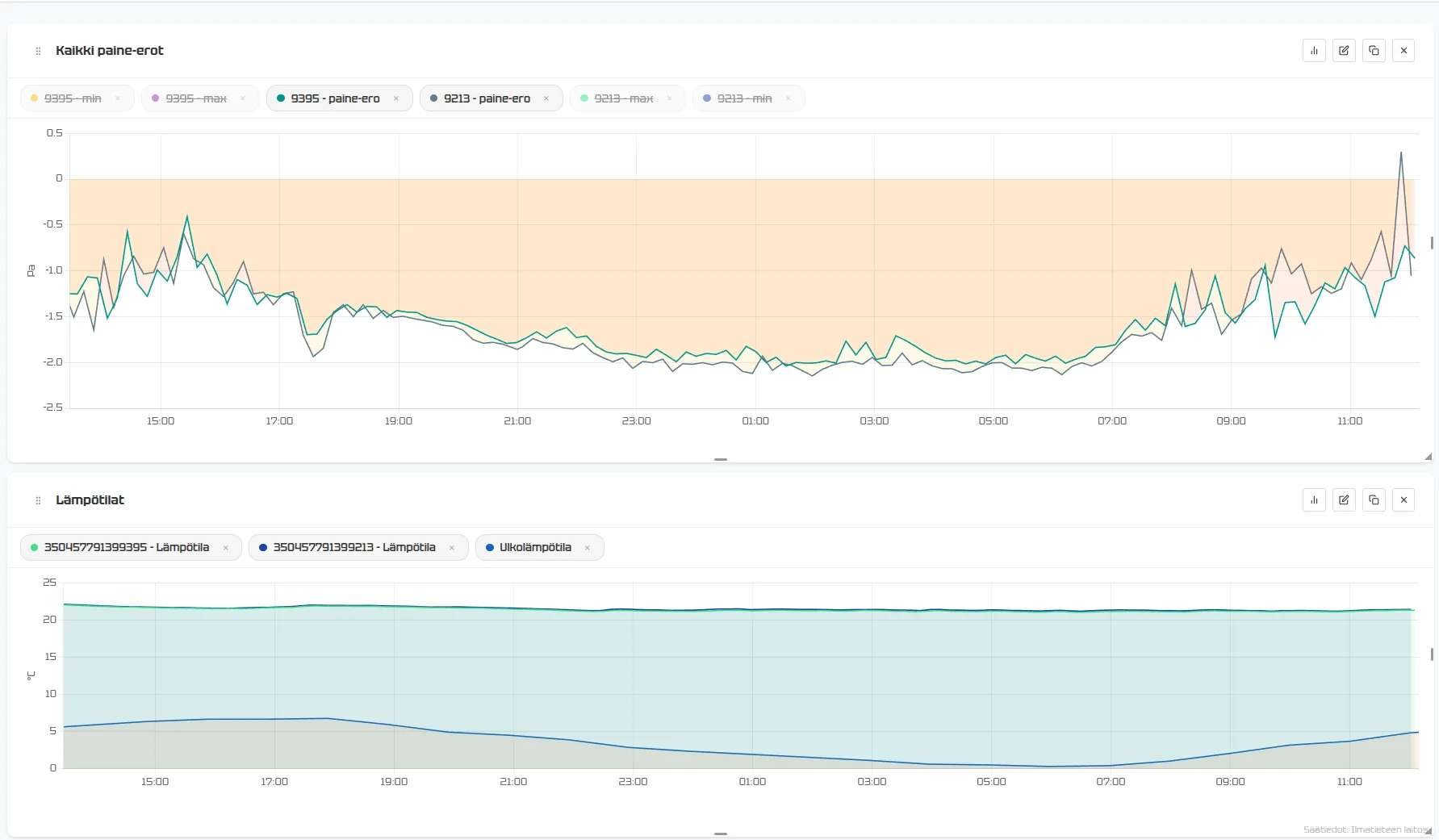
The curves match – the devices measure the same thing. We can move on to the actual test.
Test 2: The effect of device height
In this test, we wanted to find out whether the physical location of the measuring device affects the results. We moved one device close to the ceiling, about 40 cm above the wall penetration, and the other to the floor. This gave a height difference of 230 cm between the devices. The outer ends of the tubes stayed in the same place throughout.
We waited a day and then swapped the devices over. If the installation height of the device affects the measurement results, it should show up in the curves at the point where the devices were swapped.
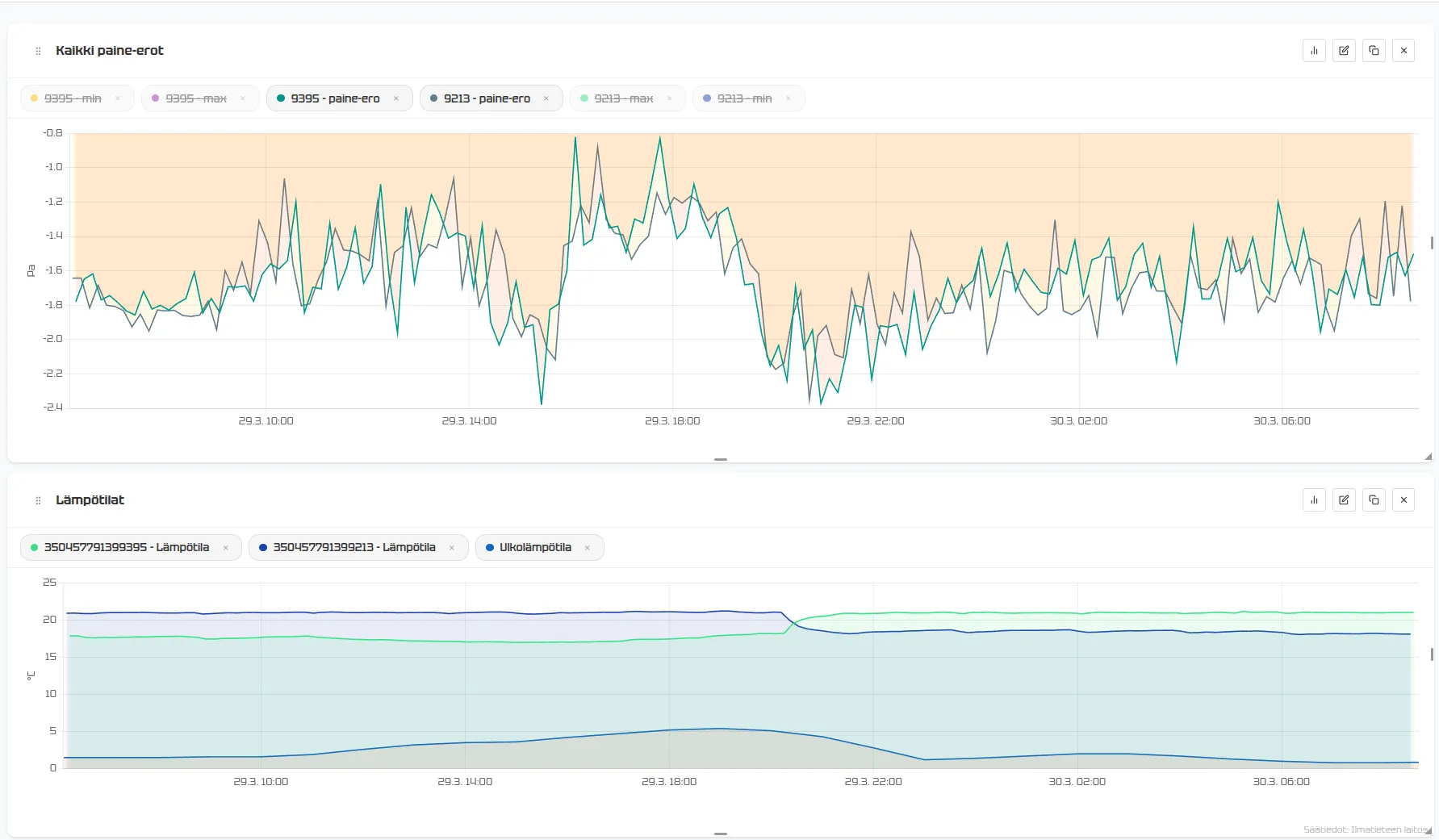
Result: no effect
This is perhaps the most surprising finding of the tests, at least for those of us who suspect thermodynamics might be some kind of Patagonian dessert. The temperature curves clearly show when the devices swap places – it is warmer up by the ceiling than down on the floor. But the pressure difference measurement doesn't change at all.
Why not? The explanation is actually quite logical. Although Loop Delta is based on airflow measurement, the airflow through the device is so small that the air inside the tube is always at roughly the same temperature as the air outside it. The same thermal forces act inside and outside the tube, and the measurement effectively compensates for itself.
Let's leave that thought to simmer and move on to the next test.
Test 3: Different floors – thermal pressure difference
By all logic, this test should show the effect of thermal pressure difference. We left one device in place downstairs and took the other upstairs to the same wall, about 3.0 m (±0.1 m) higher up. Both devices were about 2 m above the floor of their own storey – the height at which the wall penetrations happened to be.
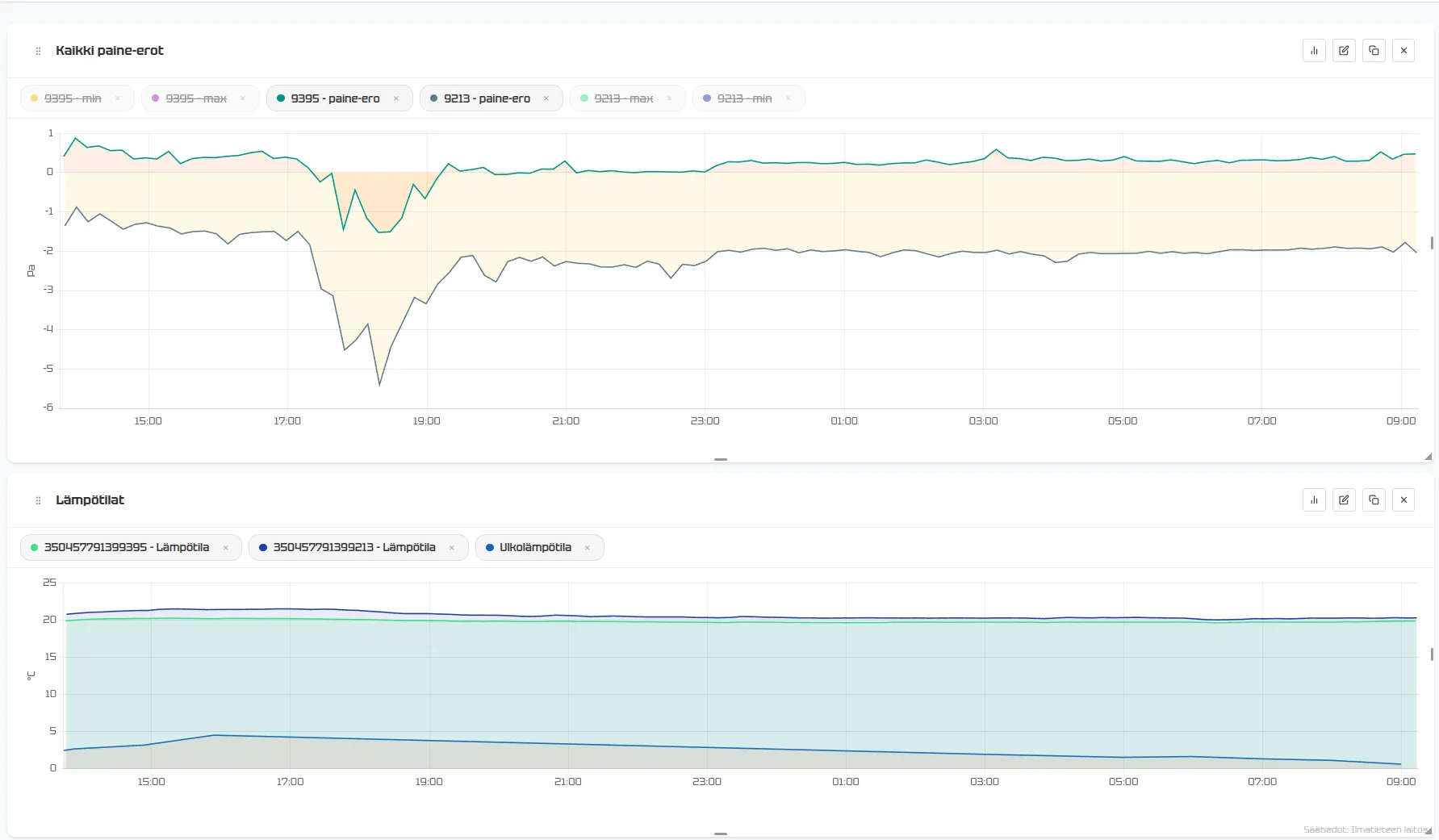
Result: a 2.3 Pa difference
Now the difference is clearly visible. The upstairs meter consistently shows about 2.3 Pa more than the downstairs meter. In fact, the upstairs is under positive pressure, while the downstairs is clearly under negative pressure. Then again, had the wall penetration been at a height of 1 m, the upstairs would also have been under slight negative pressure.
Does the theory add up?
On the test day, the outdoor temperature was about +3 °C and the indoor temperature about +20 °C, as the temperature curves show. The height difference between the devices was Δh = 3.0 m.
Thermal pressure difference arises because warm air is lighter than cold air. The difference in density between indoor and outdoor air creates hydrostatic pressures of different magnitudes at different heights, and this difference grows linearly with the height difference. The change in pressure difference between two measurement points is calculated using the formula:
ΔP = ρ₀ × T₀ × g × Δh × (1/T_out − 1/T_in)
where:
- ρ₀ = density of air at 0 °C = 1.293 kg/m³
- T₀ = 273.15 K (0 °C in kelvin)
- g = 9.81 m/s²
- Δh = height difference between the measurement points in metres
- T_out and T_in = temperatures in kelvin
Substituting the values (T_out = 276.15 K, T_in = 293.15 K):
ΔP = 1.293 × 273.15 × 9.81 × 3.0 × (1/276.15 − 1/293.15)
≈ 2.2 Pa
The measured difference was 2.3 Pa. Theory and practice match beautifully – hooray, we didn't break the laws of physics!
Test 4: Vertical runs in the reference line
In the previous test we found that the pressure is higher upstairs, and test 2 suggested that the location of the device doesn't matter. But what if the tube makes a long vertical run outside? If the meter is upstairs and the end of the tube hangs down at ground-floor level – does the device measure the upstairs or the downstairs pressure?
We left the downstairs meter in place and connected a 10-metre tube to the upstairs meter, dropping it from the upstairs wall penetration down to the same height as the downstairs penetration. If vertical tube runs really don't affect measurements, the upstairs meter should still show the upstairs pressure difference – even though the end of the tube is downstairs.
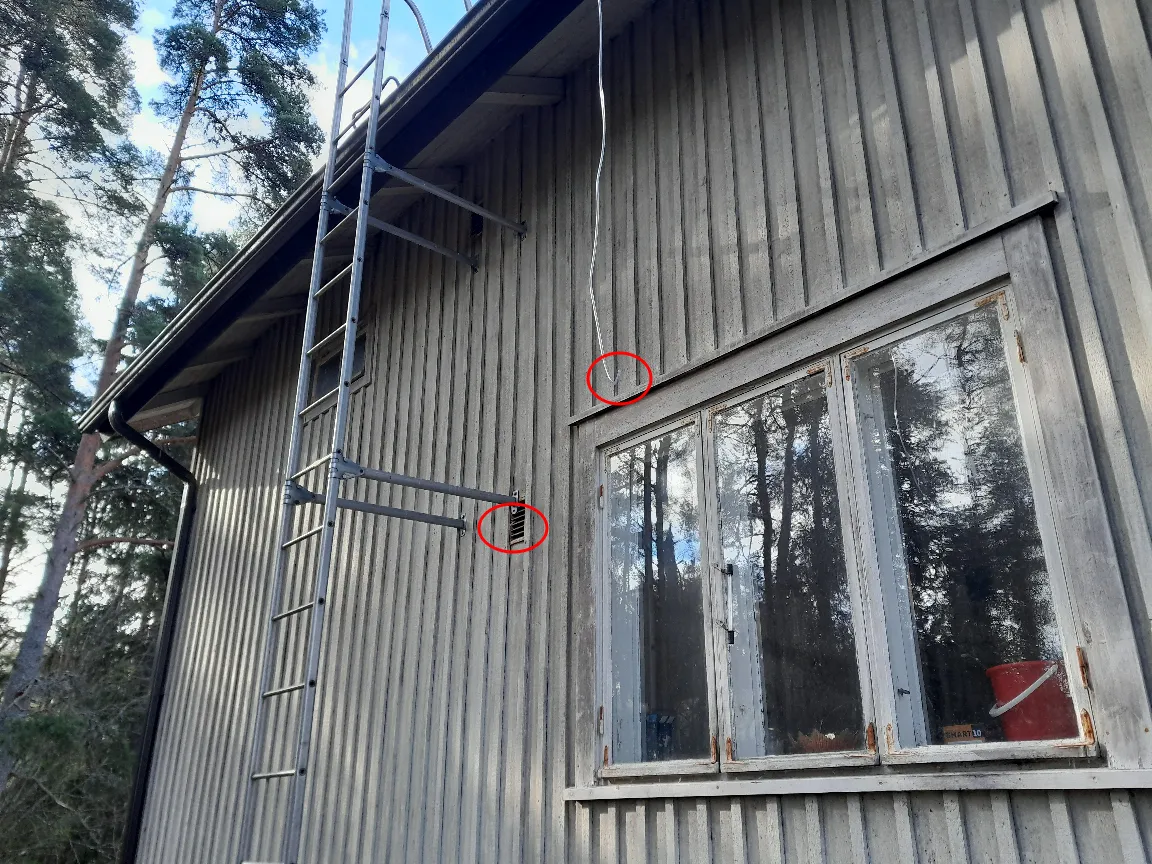
As we remember from part 1, a 10 m PVC tube causes a measurement error of about 20%. In this case, however, that is not a significant problem, because the pressure difference is close to zero: there is hardly any flow in the tube and therefore hardly any error caused by flow resistance either.
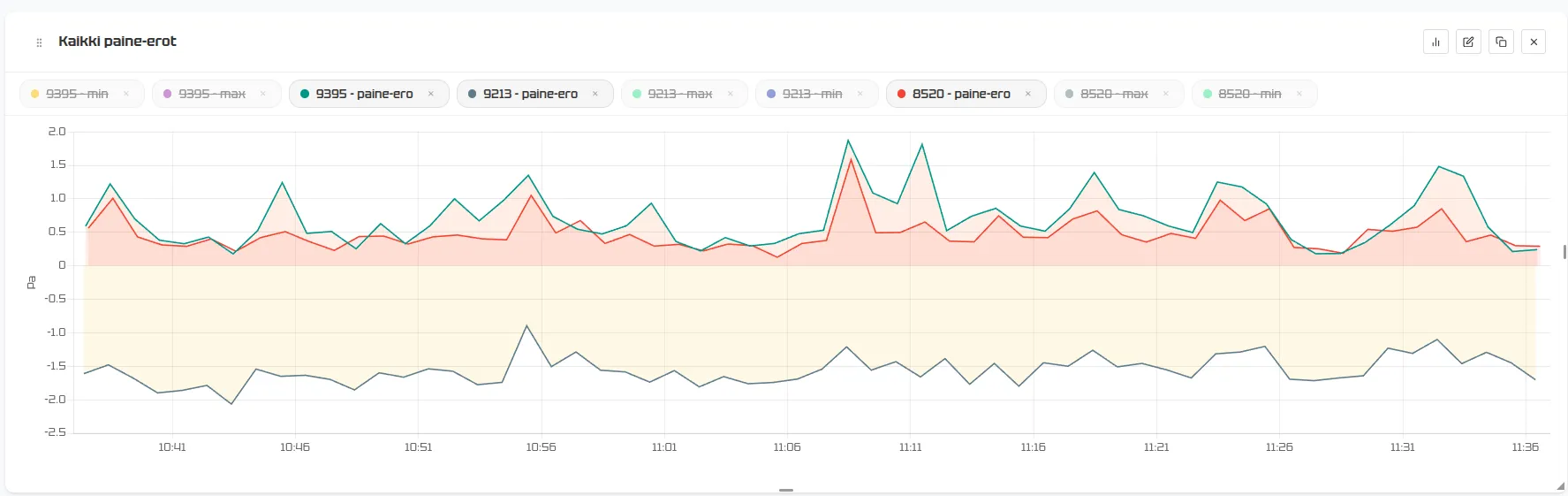
Result: vertical runs have no effect
Both upstairs devices – with a straight 3 m tube and with a 10 m tube whose end is downstairs – measure the upstairs pressure difference. The height of the free end of the tube makes no difference.
This phenomenon is the basis for the reference lines mentioned in A-Insinöörit's measurement guidelines: long tubes routed along the building's exterior wall or indoors to the desired measurement height. In practice, the only thing that affects the measurement result is the height at which the wall penetration is made – not how the meter or the free end of the tube is positioned.
A big BUT: ambient conditions
There is an important caveat, however. The test was carried out in conditions where the temperature inside and outside the tube was the same. What if:
- The sun heats up a reference line running outdoors?
- The reference line runs through a boiler room where it's 30 °C?
- Five measuring devices are connected to the same line, made of ordinary 4 mm tube?
In practice, any of these can easily ruin the measurement: the temperature of the air inside the tube differs from its surroundings and the thermal balance is disrupted, or long runs, high flow and thin tubes restrict the airflow and distort the results.
Rule of thumb for vertical runs:
- ✅ Tube in a stable environment that matches the temperature of the space being measured – OK
- ❌ Tube in changing conditions or in a space with a different temperature – not OK
Test 5: A loose tube swinging about
The results of the fourth test reveal an interesting side observation. Unfortunately, the test day was so calm that we had to cheat a little – we swung the freely hanging tube ourselves to make the phenomenon properly visible.
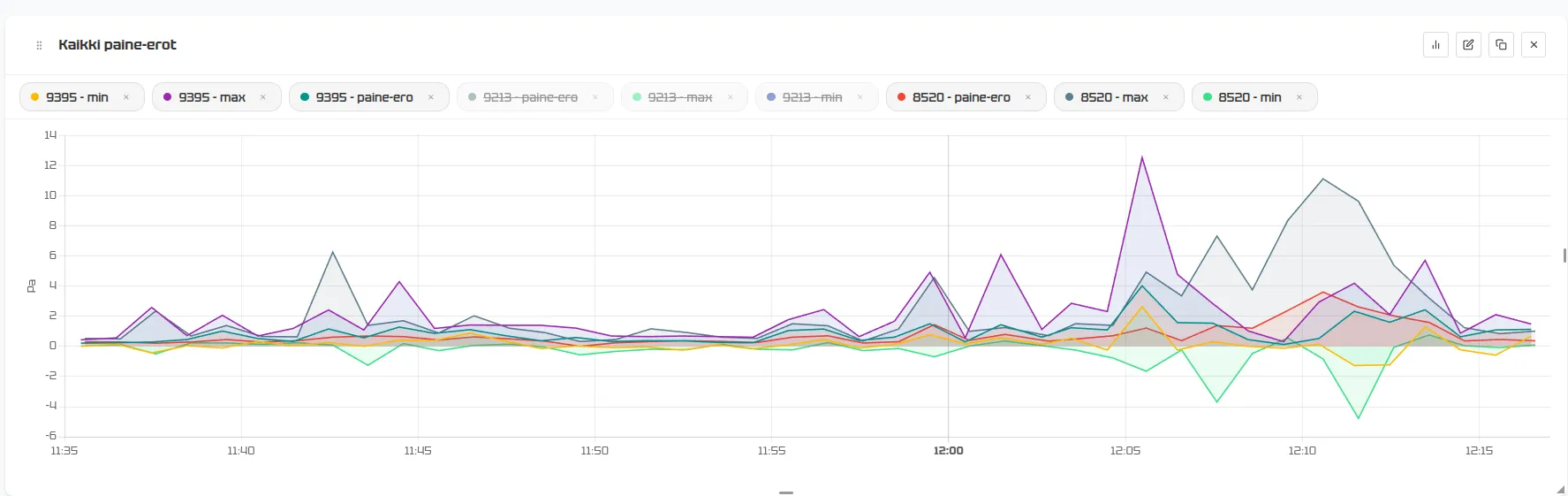
In addition to the effective average, Loop Delta reports the minimum and maximum pressure difference measured during the reporting period. When we compared the minimum pressure differences of the two upstairs meters, we saw differences: the measurement where the end of the tube hung freely towards the ground and was able to swing produced considerably larger pressure spikes than the fastened tube, even though there was hardly any difference in the effective pressure difference itself.
A swinging tube causes fluctuating pressure pulses that can show up in the measurement results. So always fasten tubes securely – a tube dangling in the wind, or for any other reason, is a source of measurement interference.
A detour: what is effective pressure difference?
We talk about effective pressure difference, or overall pressure difference. By this we mean the pressure difference that actually acts on the building.
The swinging tube, the minimum and maximum pressure differences and, more generally, the reason why pressure difference curves always seem to zigzag raise a broader question: how stable is the pressure difference in a building, really?
The answer: surprisingly unstable. Pressure difference is constantly affected by things that no measurement set-up can eliminate – people open doors, the wind blows, ventilation switches on and off. These are not measurement errors but real phenomena that affect the building.
We wanted to see – and above all show you – what this variation looks like up close. For these tests, we wrote software for the device that measures pressure difference roughly every 1 ms – that is, a thousand times a second. A high-speed camera for pressure difference, if you like.
Opening a door
What does opening the front door look like? In this test, the Loop Delta was about 9 m from the front door, on the opposite wall. There was well over 100 m² of open space inside. The door was opened and closed briskly – "oh blast, I'm late for bingo" style, but not quite the "I'm never speaking to you again" teenage door-slam.
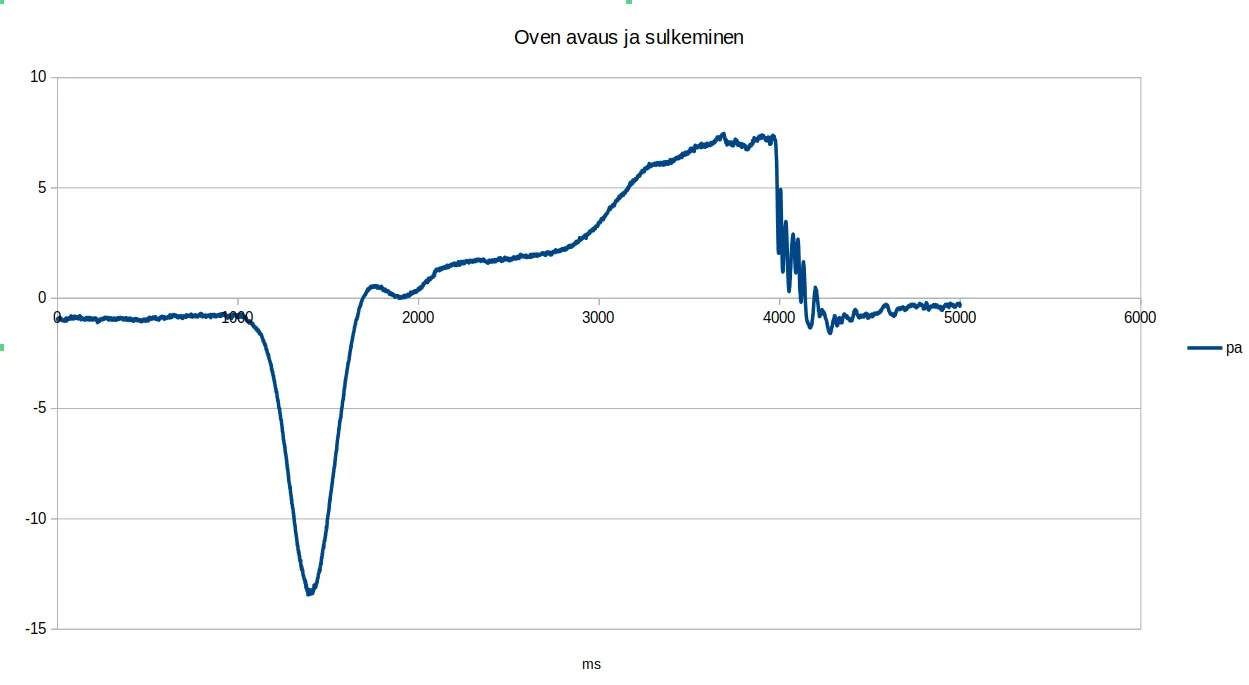
Wow! Opening the door causes a negative pressure spike of almost 15 Pa and closing it a positive pressure spike of about 8 Pa. Nine metres away, in a space of over a hundred square metres. Momentary, but real.
A "quiet" house
What about when nothing perceptible to the human senses is happening in the house? We measured pressure difference for about a minute: wind outside below 2 m/s, nobody moving about in the house. An air source heat pump was running in the same space.
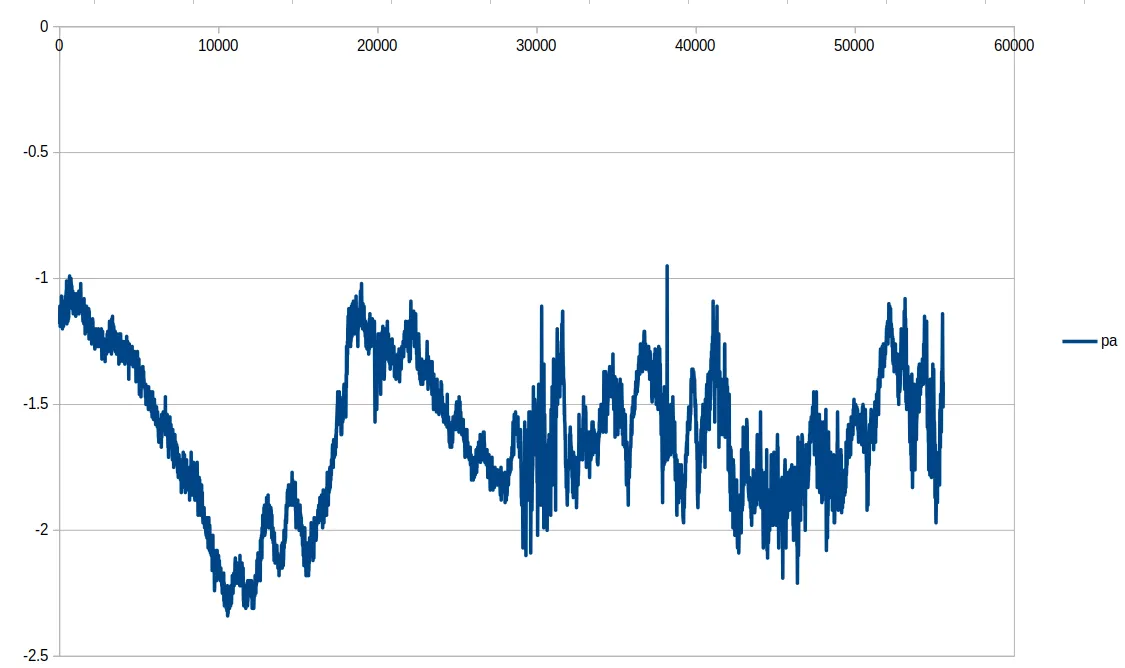
The pressure difference varies between −1 and −2.3 Pa within a single minute, rising and falling several times. In a house where "nothing is happening". This is actually so interesting that we will have to repeat the test in, say, a block of flats with mechanical ventilation. Watch this space!
What does this mean in practice?
The results show that it really matters what you measure pressure difference with, and how.
If you take a reading, say, once every 30 minutes, you get what you measure: results that tell you what happened to be going on at those particular moments. They may not have much to do with the real effective pressure difference acting on the building. If measurement continues for, say, 2 years, you will statistically probably start to approach the true average. But if you measure an actively used building for 2 weeks, for example, it is largely down to luck whether you capture the effective pressure difference or exceptional situations.
The other extreme: if you want to know a building's pressure difference with scientific precision, you would need to measure at least every 100 ms. That means 315 million measurements a year. The amount of data is staggering.
How has this been solved?
Manufacturers solve – or fail to solve – this problem in different ways. Loopshore's solution is a device that measures pressure difference at a high rate, filters out anomalies and reports the estimated effective pressure difference that acted on the building over a user-selected period (10 s – 24 h). In addition, the device reports the measured minimum and maximum pressure differences, which show whether the pressure difference has been stable or has fluctuated a lot.
Summary
- The measuring device must be installed at the height of the wall penetration – Refuted. The height of the measuring device or the free end of the tube makes practically no difference
- Pressure difference differs between floors (thermal pressure difference) – Confirmed. A 2.3 Pa difference with a height difference of 3.0 m – matching the theoretical 2.2 Pa
- Vertical tube runs affect measurement results and should be avoided – Possible. Dropping a 10 m tube from upstairs to downstairs did not change the result. Note, however, the other factors that affect vertical runs
- The way the tube is fastened affects measurement results – Confirmed. A swinging tube causes interference spikes in the min/max values, which the device may or may not filter out.
Practical recommendations
- The height of the wall penetration is what counts. In practice, the measurement result is determined by the height at which the penetration through the exterior wall is made – not by the location of the measuring device or the free end of the tube. Install the penetration at a height of 1 m, and if you deviate from this significantly, take it into account when interpreting the results.
- Take thermal pressure difference into account. Especially in winter, pressure rises steeply as you move upwards in a building. Measure at a height of 1 m as the guidelines instruct, or take the height into account when interpreting the results.
- Fasten tubes securely. A moving measurement tube can cause interference spikes that may distort the results.
- Keep reference lines at a stable temperature. Sunshine or warm spaces along the tube's route can ruin the measurement.
- A single measurement doesn't tell the whole story. Pressure difference in a building varies constantly – determining the effective pressure difference requires frequent, long-term measurement.
In the next part, we look at how wind affects pressure difference measurement on different sides of a building.