
Abbreviations used: EC = Elemental Carbon, OC = Organic Carbon, PM = Particulate Matter, HTP = HTP value (Finnish occupational exposure limit, literally "concentration known to be harmful")
Diesel engine exhaust contains a significant amount of fine particles (PM), a large proportion of which are carbon-based. The occupational exposure limit for diesel exhaust particles has been set at 0.05 mg/m³ for elemental carbon (EC) in the respirable fraction over an 8-hour HTP-8 reference period, and it is a binding limit for worker exposure. In diesel emissions, EC is a reliable indicator of particle concentration, as it correlates well with combustion-derived particle mass.
How can EC exposure be assessed in practice?
A traditional workplace exposure study requires sampling from the breathing zone and laboratory analysis of EC, but continuous laboratory measurements are challenging and slow. That's why combining EC estimates with real-time PM measurements is an effective way to monitor EC exposure in practice.
The Loopshore method makes use of:
-
Real-time fine particle measurement (e.g. PM₂.₅ or respirable fraction measurement),
-
The laboratory-analysed ratio of EC to PM mass in samples taken from the working environment.
Once the EC share of PM mass is known from laboratory methods (or, failing that, a conservative default is used that assumes 75% of the measured particle mass is EC – see below), real-time PM measurements can be scaled to correspond to the EC concentration. This provides a continuous estimate of EC exposure without every sample having to be processed separately in a laboratory.
Why a 75% default value?
In chemical analyses of diesel particles, EC often makes up a large share of the carbon in fine particle mass. Published particle analyses report that the share of elemental carbon in the total carbon content of PM varies, but is often around 50–75% under certain diesel exhaust conditions. The calculation makes the simplifying assumption that 75% of the entire measured particle mass is EC. This assumption is deliberately conservative: the literature figure describes EC's share of carbon, and particles contain more than just carbon, so EC's actual share of particle mass is usually lower and the assumption tends to overestimate rather than underestimate the EC concentration. This is why the 75% default works as a conservative screening tool when conditions at the site are similar to the analysed reference situations (e.g. diesel emissions from heavy machinery, or concentrations measured while engines are running).
The default value is not always a substitute for a site-specific analysis, but it is a practical starting point for real-time monitoring, especially when:
-
the EC share of PM mass is likely to be high (work is done close to diesel engines),
-
you want a quick understanding of exposure levels relative to the HTP-8 limit value.
How is EC HTP-8 calculated from real-time data?
-
Collect real-time PM measurement data (e.g. PM₂.₅ or respirable fraction concentration).
-
Apply the EC share as a default value, e.g. 0.75 (i.e. 75% of the PM value).
-
Calculate the 8-hour HTP-8 time-weighted average (TWA) for EC as follows:
-
If the real-time PM₂.₅ is, for example, 0.10 mg/m³, EC can be estimated at 0.075 mg/m³ (0.10 mg/m³ × 0.75).
-
The 8-hour TWA EC value is then calculated and compared with the limit value of 0.05 mg/m³.
-
This approach enables operational, continuous monitoring and illustrates the level of potential exposure relative to occupational limit values. It also supports decision-making: if the estimated EC HTP-8 exceeds the limit value, it's time to target control measures or further measurements.
Benefits
-
real-time visibility of EC exposure over the working day;
-
fast early warning of situations where EC concentrations may approach or exceed the limit value;
-
a scalable and practical alternative to continuous laboratory measurement.
Cost-effective EC HTP-8 monitoring with Loopshore's cloud service and measuring devices
In Loopshore's cloud service, EC HTP-8 monitoring is based on a default value proven to work in practice, which sets the share of elemental carbon in the measured fine particle mass at 75%. This starting point is conservative but sensible: it draws on published research into the particle composition of diesel exhaust, while providing a safe margin for exposure assessment. Combining real-time PM measurement with this default value and the HTP-8 time-weighted average calculated in the cloud service gives continuous, cost-effective and operationally useful visibility of EC exposure. The solution does not replace laboratory measurements when they are needed, but it gives construction sites and industrial environments exactly what exposure management requires: predictability, decision support and the ability to step in before limit values are exceeded.
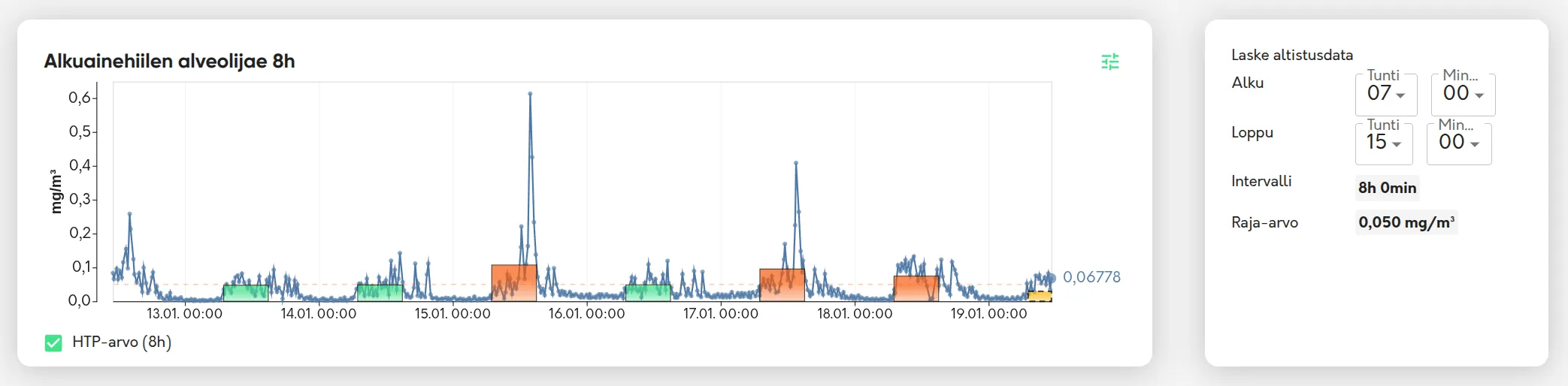
**
Fine particles in the working environment can be reliably monitored by** measuring.