
A ground source heat pump stops again and again, but almost always starts up again after a reset. The alarm points to flow or temperature, even though nothing actually seems to be broken. The unit may run flawlessly for days until the same thing happens again. In this post, we explain how this kind of hard-to-reproduce fault was tracked down by combining time series data from a Loopshore measuring device, AI analysis and human observations – and why the solution was only found once we looked at how the unit behaved over time instead of at individual alarm codes.
The problem: an alarm with no clear cause
The unit in question was an older ground source heat pump (NIBE Fighter series) that kept stopping with an alarm. The alarm related to flow and supply temperature, but practical observations did not point to an actual flow problem:
-
the circulation pump was running
-
flow could be heard in the pipework
-
the unit worked normally after a reset
Even so, the pump kept locking into alarm mode. It's a situation many will recognise: the unit isn't clearly broken, but it isn't reliable either – it shuts down and the shower runs cold.
Why the manufacturer's own diagnostics weren't enough
In older ground source heat pumps, diagnostics are typically based on:
-
individual sensors
-
fixed limit values
-
binary alarms (OK / not OK)
Diagnostics like these only tell you that a limit value was exceeded – not how the unit behaved over time. If a single sensor gives a faulty signal, the alarm looks just the same as it would for a real fault, and the cause cannot be deduced from the alarm code alone.
Loopshore measurement: temperature behaviour reveals more than the alarm
A Loopshore measuring device had been installed at the site to continuously monitor the temperature of the hot water tank. This data gave a completely new view of the situation.
The time series revealed a clear, recurring pattern:
-
the tank temperature rose normally
-
then suddenly dropped sharply
-
the temperature did not recover without a reset
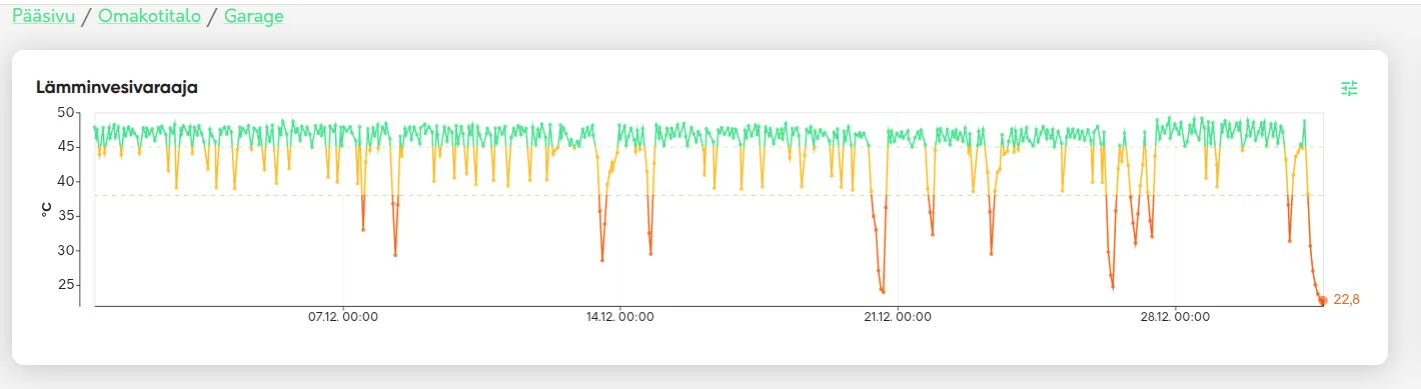
What mattered was what was not seen:
-
no gradual cooling
-
no profile suggesting hot water use
-
no dependence on load
It wasn't a lack of heat, but a controlled shutdown.
The role of AI: abnormal behaviour, not an abnormal value
The AI analysis focused specifically on the shape of the temperature behaviour:
-
the rate of change
-
how often it recurred
-
its structure over time
The analysis showed that the temperature crashes were:
-
too fast to be normal cooling
-
too regular to be random
-
linked to the unit stopping, not to consumption
This narrowed down the nature of the fault: it wasn't a problem with heat production, but a safety function being triggered by a misinterpretation.
Human observations completed the diagnosis
Although the data and analysis took us a long way, the decisive step was bringing human observations into the picture:
-
the first reset almost always restored operation
-
there really was flow
-
the fault occurred at random, often when the temperature was rising
When these were combined with the Loopshore data and the AI's findings, the most likely cause stood out clearly: a faulty signal from an ageing flow switch (flow sensor).
There was no real flow problem – the control system just thought there was.
What did we learn?
This case demonstrates three key points:
-
A single alarm doesn't tell the whole story
-
Data over time reveals behaviour patterns that the control system can't see
-
The best results come when data, AI and people work together
Neither Loopshore nor AI replaces servicing or human decision-making – but they make troubleshooting more precise, faster and more reliable.
Summary
When a ground source heat pump stops repeatedly for no obvious reason, the answer is rarely found in a single alarm code. In this case, it took external measurement, AI analysis and practical observations together to reveal the real cause.
It wasn't a complicated fault – the problem had simply been looked at from too narrow a perspective.
Link to the troubleshooting conversation with ChatGPT: https://chatgpt.com/share/69563818-1dac-800d-b4b1-25fb0119786c