
Air humidity affects the indoor environment in many ways. Among other things, humidity affects the body's heat balance, how much we sweat, the voice and many other bodily functions. Humidity is also indirectly linked to the dust content of room air, as it affects static electricity in materials.
What is relative humidity?
Relative humidity is the amount of water vapour in the air relative to how much moisture the air could hold before it condenses into water. Relative humidity changes as the temperature changes, because warm air can hold more absolute moisture than cold air.
What is air humidity?
Air humidity refers to the amount of water vapour (water vapour = water in its gaseous state) in the air. Absolute humidity expresses the mass of water vapour per unit volume of air. The unit g/m³ is generally used in observations.
What is absolute humidity?
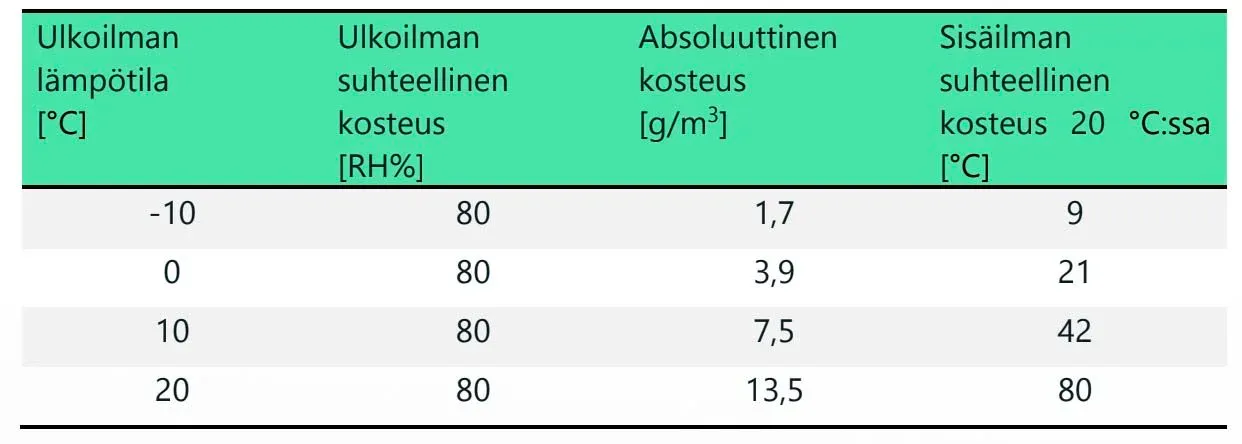
Absolute humidity expresses how much water vapour there is in one cubic metre of air, usually in grams (g/m³). Absolute humidity does not change when the temperature changes, unless the temperature drops so much that air at that temperature can no longer hold as much moisture as it did to begin with. The water vapour then condenses into water.
What affects the relative humidity of indoor air?
Outdoor weather conditions and changes in them have a direct effect on the relative humidity of indoor air. In winter, outdoor air contains little moisture but has a high relative humidity. The relative humidity of outdoor air is 65–75% in summer and 85–90% in winter.
Indoors, moisture comes from people, cooking, cleaning, laundry, showers and ventilation, among other things. Moisture in indoor air spreads evenly throughout the space and does not form layers. Moisture, heat and impurities are removed via the exhaust ventilation.
If moisture condenses on surfaces, further investigation is needed.
When an indoor space is under positive pressure, more moisture flows into the structures through air leakage points. When an indoor space is under negative pressure, the temperature of the inner surface may drop at air leakage points.
Excess moisture in indoor air can condense on cold surfaces and increase the risk of microbial growth on surfaces and, further, in the structures, thereby impairing indoor air quality. Condensation, especially on window sills, has been associated with indoor air problems. These, in turn, are linked to inadequate ventilation or an incorrect pressure difference across the building envelope.
Keep your humidifier clean and measure air humidity
Room air can be humidified. However, humidification is challenging in terms of air handling system hygiene. A poorly maintained humidifier can become a source of microbial contamination, because the presence of water is a critical factor in microbial growth. Humidifiers must therefore be clean, correctly selected and well maintained. Humidifying room air above 35% relative humidity should be avoided, which is why measuring the air is important.
The Loop One measuring device developed by Loopshore Oy lets you monitor indoor conditions, such as changes in relative humidity, in real time. This makes it possible to ensure the best conditions, for example by adjusting the ventilation – which in turn can save energy.
Moisture loads arise in all spaces
Moisture loads arise in all buildings and spaces. They may come from people, from variations in outdoor humidity, from human activities or the intended use of the space, or from the environmental requirements of the space.
In homes, in addition to the occupants themselves, moisture loads come from washing, cooking, doing laundry and moisture evaporating from houseplants, among other things. The characteristics of a moisture load, such as its size and duration, can vary. The most important characteristics of a moisture load are its duration and magnitude. Loads can often be divided into continuous and momentary loads, and into those that do and those that do not raise the enthalpy of indoor air. Enthalpy describes the heat content of the air in question together with the water vapour it contains. Good examples of momentary moisture loads that raise indoor air enthalpy are a shower or a sauna, and examples of continuous ones are drying laundry, moisture from people and structures drying out.
Indoor air that feels pleasant
Temperature and humidity affect how people perceive air quality, even during short-term exposure. When indoor air is clean, dry and cool, occupants find it pleasant. As humidity increases and the temperature rises, even clean air starts to feel uncomfortable. No precise limits or target values have been set for the relative humidity of indoor air.
Dry indoor air or overly humid indoor air?
Dry indoor air is known to slow down the movement of the cilia in the respiratory tract and impair the clearance of mucus from the airways. This reduces the ability of the mucous membranes to fight off infections. Symptoms caused by dry indoor air can be reduced by humidifying the room air or lowering the room temperature.
When humidifying, the moisture addition must be taken into account (the extra moisture generated indoors should not raise the moisture content of indoor air by more than about 3–4 g/m³). When humidifying, the relative humidity of indoor air should be controlled so that it does not rise so high that moisture condenses on cool surfaces. In general, the aim is to keep buildings under slight negative pressure relative to the outdoor air.
If a building is under positive pressure, warm indoor air travels into the structures through leakage points. The moisture bound in the warm air can then condense on cold structural components, causing moisture damage.
Indoor air humidity is an important quantity to monitor in all kinds of buildings. In addition to sensory observations and user experiences, it is also a good idea to monitor it by measuring.