

Human senses alone cannot be used to measure indoor air quality. Symptoms that people experience may be a sign that the indoor air could be improved. An environmental monitor, air quality monitor, indoor air sensor or whatever you choose to call a device that produces air quality information is then a tool that provides facts. Read more about what makes a good air quality monitor.
Accurate and versatile
A good air quality monitor measures indoor air quality as accurately as possible. The best possible components and versatile measurement features have been carefully chosen for the product, so that it gives a sufficient overall picture of the indoor air. It measures quantities such as temperature and humidity. In addition, it can monitor, for example, VOCs, fine particles or carbon dioxide levels. Conclusions can also be drawn by comparing the results for different quantities with each other.
Easy to use
When an indoor air measurement device is easy to set up, it is useful in situations where an overall picture of indoor air quality is needed on a tight schedule. Push-button measurement makes for a quick start. Indoor air measurement with independently operating sensors can then also be moved easily from one space to another.
The measurement results should be password-protected, but quick to glance through. A clear view of the air quality data is just as important as a working device. Clear presentation is essential especially when, besides indoor air experts, the real-time results are also viewed by the end customer, occupational health care or the authorities, for example.
Wireless and reliable data transfer
It is worth paying attention to how an air quality sensor transfers its data. A LoRaWAN network based on LPWAN technology is reliable, but the radio network does not cover all of Finland. The Sigfox radio network also has coverage gaps.
Some indoor air sensors use a Wi-Fi network for data transfer. Devices that use the mobile network can operate in a wider range of environments than Wi-Fi devices. The coverage of an IoT environmental sensor operating on the 4G mobile network is generally better than that of radio networks, globally too.
A wireless indoor air monitor does not depend on the location of power outlets, and an air quality sensor that operates independently, without a central unit, can be installed in almost any space or building.
Stores the measured air quality data
When an air quality monitor can be read remotely, the results are quickly available, and there is no need to download or transfer the device's data by visiting the site at regular intervals.
A small data logger is suitable for short-term monitoring and documentation. When air quality data needs to be stored over a long period, a cloud-based solution that keeps the history is a better choice.
Upgradable and durable
A good air quality monitor also stands the test of time. It can be updated, or repaired if a fault occurs. When air quality monitoring lasts for years, reliable operation of the device is key.
Low power consumption is a feature you are entitled to demand from all kinds of devices, whether a light logger or a more robust environmental monitor. Besides producing less waste, an air quality monitor with a rechargeable battery has the advantage over battery-powered ones that it is easy to charge with an ordinary phone charger.
Alarms, notifications and limit values
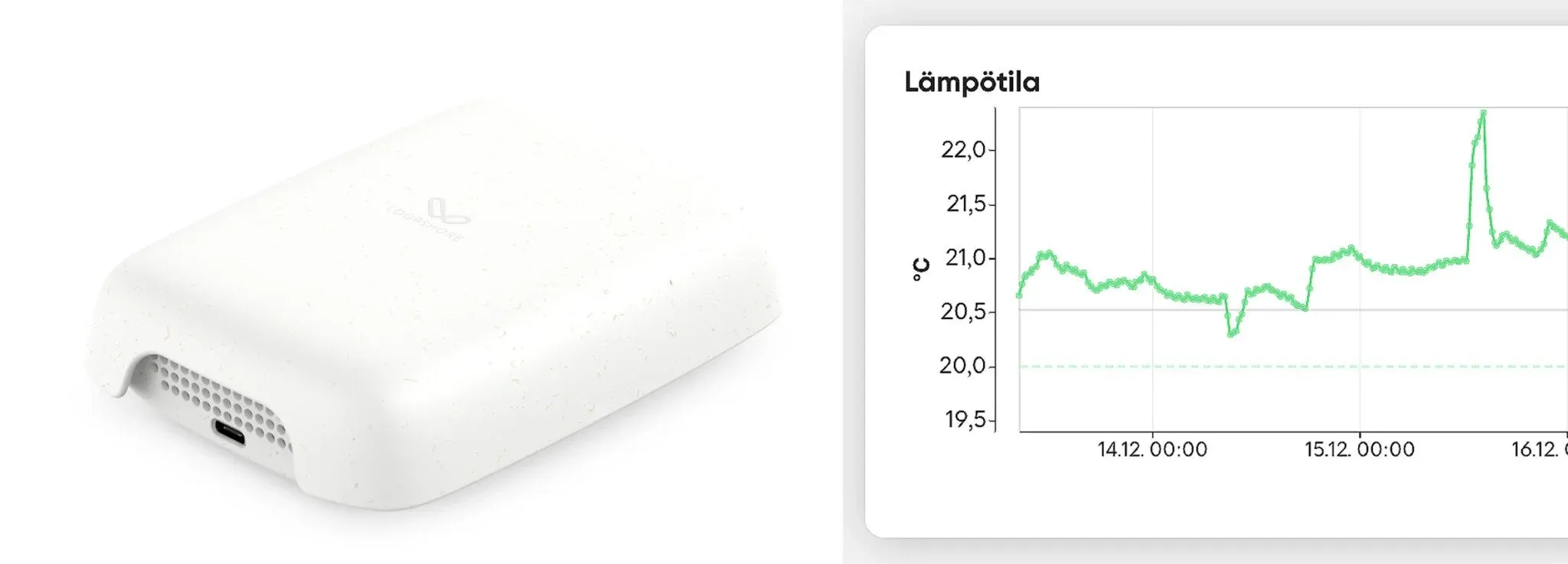
Environmental monitoring can work either independently or as part of building automation. Adjustable limit values make it possible to monitor spaces whose conditions differ from the usual, such as the air quality of a cool remote storage facility, and automatic alarms make it easier to keep track of the situation. The device's automatic alarms enable an effective monitoring system in buildings where the building's own alarm system does not provide enough information.
Support and customer service in Finnish
When problems arise, and as help in interpreting indoor air measurement results, customer service in Finnish saves time and most likely money too.
Experiences of a particularly good or bad air quality monitor?
Share them with us at info(at)loopshore.com or on LinkedIn.